

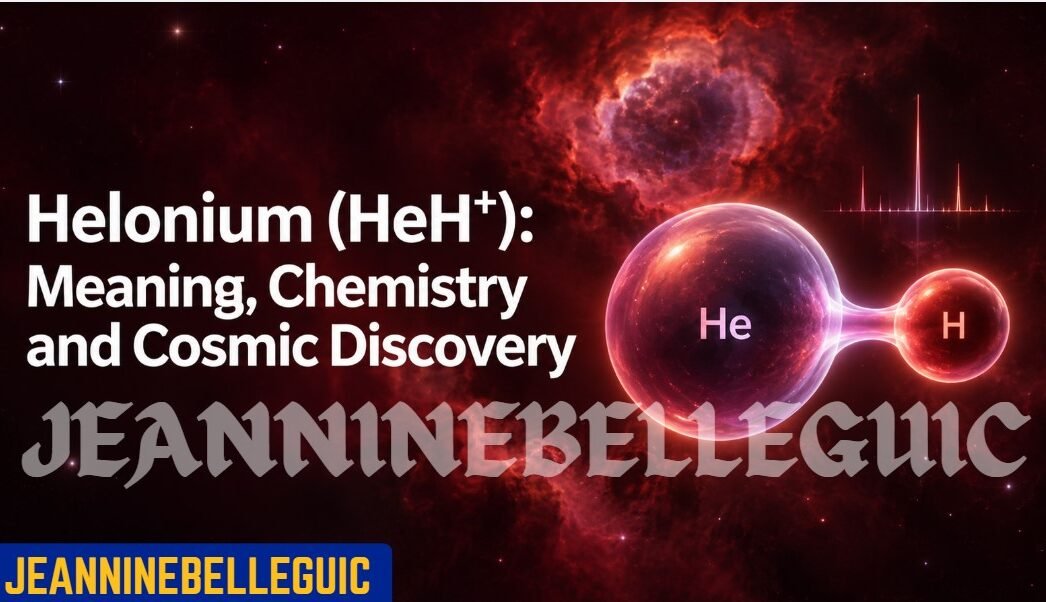
Helonium is a name for the helium hydride ion, written as HeH⁺. It is a positively charged molecular ion formed from helium and hydrogen. It is not a newly discovered element, a commercial chemical or an acid that can be stored in a bottle.
Scientists study helonium because early-universe models identify HeH⁺ as the first type of molecular bond to form after the Big Bang. However, the famous 2019 discovery did not recover an ancient molecule left over from that period. Instead, astronomers detected the same molecular species in the planetary nebula NGC 7027, where suitable conditions produce it today.
Helonium at a glance
| Property | Verified description |
|---|---|
| Common name | Helonium or helium hydride ion |
| Systematic name | Hydridohelium(1+) |
| Formula | HeH⁺ |
| Net charge | +1 |
| Chemical class | Diatomic molecular cation |
| Average mass | Approximately 5.011 |
| Laboratory identification | 1925 |
| First confirmed detection in space | 2019 |
| Astronomical source | Planetary nebula NGC 7027 |
The ChEBI chemical database records the formula as HHe, the net charge as +1 and the systematic name as hydridohelium(1+). In astronomical and chemical literature, the more familiar notation is HeH⁺.
What the HeH⁺ formula tells us
The formula contains three important pieces of information:
- He represents helium.
- H represents hydrogen.
- The superscript + shows that the species has one positive charge.
A useful way to picture early-universe helonium is a neutral helium atom bonded to a proton:
The symbol represents a photon. The photon carries away energy, allowing the newly formed bond to remain together. Chemists call this process radiative association.
The plus sign should not be omitted. The scientifically important species is the ion HeH⁺, not an ordinary neutral HeH molecule.
Four popular claims, checked carefully
“Helonium was the first molecule in the universe”
This is a useful summary, but it requires context. Standard models of primordial chemistry predict that HeH⁺ supplied the universe’s first molecular bond after temperatures fell below roughly 4,000 kelvin.
Helium recombined before hydrogen. Consequently, neutral helium atoms briefly existed alongside positively charged hydrogen nuclei. That combination allowed HeH⁺ to form. NASA places this stage at roughly 100,000 years after the Big Bang, although exact timing descriptions vary with the cosmological model and with how the recombination period is defined.
Therefore, the precise wording is:
Helonium is the first molecular ion predicted to have formed in significant early-universe chemistry.
This is a model-based reconstruction supported by laboratory chemistry and modern astronomical detection. It is not a direct observation of an individual molecule from the early universe.
“Helonium was discovered in 2019”
That statement confuses two separate events.
Helonium was identified in laboratory experiments in 1925 by T. R. Hogness and E. G. Lunn. What happened in 2019 was the first unambiguous astronomical detection of HeH⁺ in interstellar space.
This distinction matters because scientists already knew the ion could exist. The unresolved question was whether instruments could find its spectral signature in a natural astronomical environment.
“Helonium is the strongest acid”
The statement refers primarily to gas-phase proton-transfer chemistry.
NIST’s proton-affinity data give helium a proton affinity of approximately 177.8 kJ/mol. A low proton affinity means that protonated helium—HeH⁺—is exceptionally willing to transfer its proton to another suitable neutral species. This is the basis for describing helonium as an extraordinarily strong gas-phase Brønsted acid.
However, comparisons with sulfuric acid, fluoroantimonic acid or aqueous pH can be misleading. Acid strength depends on the environment and the measurement scale. HeH⁺ is a short-lived gaseous ion, whereas familiar acids are discussed as solutions or condensed materials.
Helonium cannot be handled as a bottled superacid. In ordinary matter, it would rapidly participate in proton-transfer or destruction reactions.
“Helium does not form chemical bonds”
Neutral helium is famously unreactive under everyday conditions, but “unreactive” does not mean that no helium-containing species can ever exist.
Ionized gases, plasmas and low-density astronomical environments provide conditions very different from a laboratory flask. In those settings, helium can take part in a stable molecular ion such as HeH⁺. The existence of helonium is therefore not an exception to quantum chemistry; it is an example of how chemical behaviour changes with charge and environment.
Helonium’s place in the first chemical network
Helonium was important because it provided one route from individual atoms and ions toward molecular hydrogen.
After HeH⁺ formed, it could react with neutral hydrogen:
The resulting could then participate in reactions leading to molecular hydrogen, . The 2019 Nature paper describes this as an early path toward hydrogen-molecule formation—not as proof that every later molecule descended directly from helonium.
That distinction prevents an attractive scientific story from becoming an exaggeration. HeH⁺ was an early participant in a network of reactions. It was not a complete chemical ancestor of every substance in the modern universe.
Why astronomers looked at NGC 7027
NGC 7027 is a young planetary nebula approximately 3,000 light-years away in the direction of Cygnus. Despite the name, a planetary nebula is not a planet. It is an expanding shell of material expelled by a dying star.
Its hot central star produces intense ultraviolet radiation. This creates an ionization boundary where ionized helium and neutral hydrogen can coexist. Under those conditions, models predict HeH⁺ formation mainly through a reaction between He⁺ and H:
Notice that this is not identical to the commonly described primordial pathway involving neutral He and H⁺. The same molecular ion can form through different routes when the ionization conditions change.
How the 2019 detection worked
Molecules rotate and vibrate only at particular energy levels. When a molecule changes state, it absorbs or emits radiation at characteristic frequencies. These spectral lines act like fingerprints.
For HeH⁺, the researchers targeted its ground-state rotational transition at approximately:
- 2.010 terahertz, or
- 149.1 micrometres in wavelength.
Earth’s lower atmosphere is effectively opaque at this far-infrared wavelength, largely because atmospheric water vapour absorbs the radiation. The observing team therefore used the GREAT spectrometer aboard SOFIA, a modified Boeing 747 carrying a telescope above most atmospheric water vapour.
The team also had to separate the HeH⁺ signal from nearby spectral features produced by CH. The published analysis used observations with two receiver settings and modelled the neighbouring CH emission before combining the residual spectra. The resulting line matched the expected HeH⁺ transition toward NGC 7027.
Importantly, the observation detected newly formed helonium in NGC 7027. It did not observe the original HeH⁺ population from shortly after the Big Bang.
Independent spectral evidence followed
In 2020, another research team reported two rovibrational HeH⁺ emission lines at approximately 3.516 and 3.608 micrometres. These observations were made with the iSHELL spectrograph on NASA’s Infrared Telescope Facility in Hawaii.
Because these were different transitions observed with a different instrument, they strengthened the identification of HeH⁺ in NGC 7027. The measured line strengths did not all match the existing models perfectly, however. Some observed emissions were more than twice as strong as initial predictions, indicating that the chemistry and excitation conditions still needed refinement.
What scientists are still trying to learn
Detection settled the question of whether HeH⁺ exists naturally in interstellar space, but it did not finish the research.
A 2025 modelling study examined the three observed HeH⁺ emission lines using updated reaction rates and non-equilibrium calculations. Its authors achieved a better match between models and observations, while concluding that additional spectral lines would be needed to constrain the temperature, electron density and HeH⁺ abundance more reliably.
As of a July 2026 instrument-study preprint, NGC 7027 was still described as the only astronomical source with a HeH⁺ detection. Astronomers would particularly value observations from more distant environments because those could test how helonium behaves under conditions closer to different stages of cosmic history.
Why helonium matters
Helonium connects three different areas of science:
- Fundamental chemistry: It demonstrates that helium can participate in a molecular bond when charge and environmental conditions permit it.
- Cosmology: Its reaction network helps scientists model the transition from a universe of ions and atoms to one containing molecules.
- Astronomical spectroscopy: Its detection shows how high-resolution infrared instruments can identify extremely reactive and uncommon ions from their spectral fingerprints.
Its greatest scientific value is therefore not a practical use on Earth. Helonium acts as a test of whether laboratory measurements, quantum calculations and astronomical models describe the same chemistry.
The accurate one-sentence definition
Helonium is the positively charged helium hydride ion HeH⁺, a highly reactive gas-phase species predicted to have formed the universe’s first molecular bond and first detected in interstellar space in NGC 7027 in 2019.
Next post : 20xBusiness.com: A Practical Reader’s Guide to Its Content and Credibility