
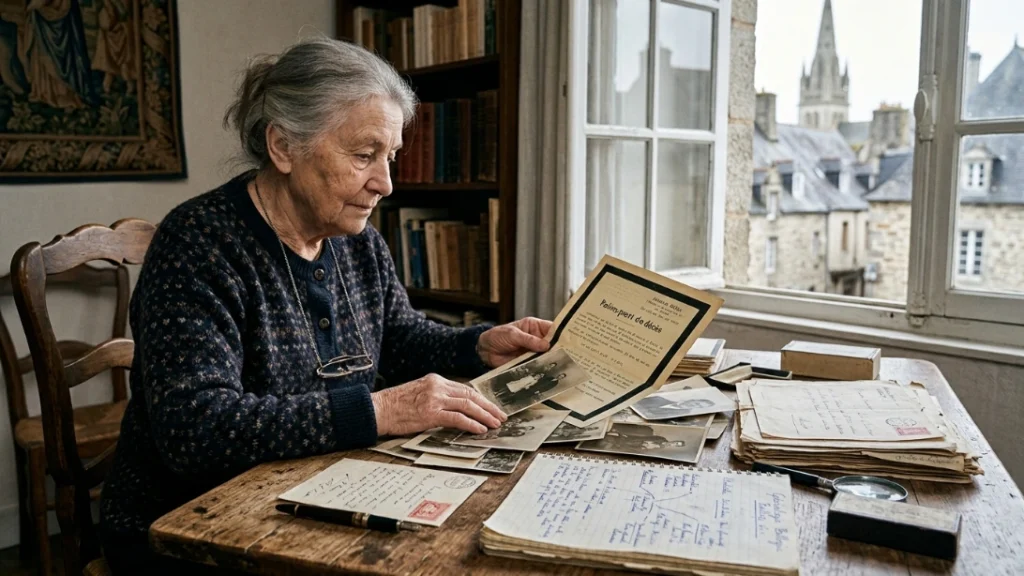
Jeannine Belleguic became the subject of several online biographies after her death in April 2025. A closer look at the original French death notice tells a more interesting story: her family identity is well documented, while parts of her online professional biography are not.
The notice also contains a small detail that can easily cause future confusion. Another woman named Jeannine Bleuzen is identified as her sister-in-law.
The clearest starting point is the French death notice for Madame Jean-Charles BELLÉGUIC, née Jeannine BLEUZEN.
It records her death on Friday, April 18, 2025.
The notice is associated with the Quimperlé area and names several family members. Unlike short database entries, it provides actual relationships and funeral information.
The specific death notice is available through Dans Nos Coeurs.
A separate Cybille.fr record lists Jeannine as 93 years old and displays 1931–2025.
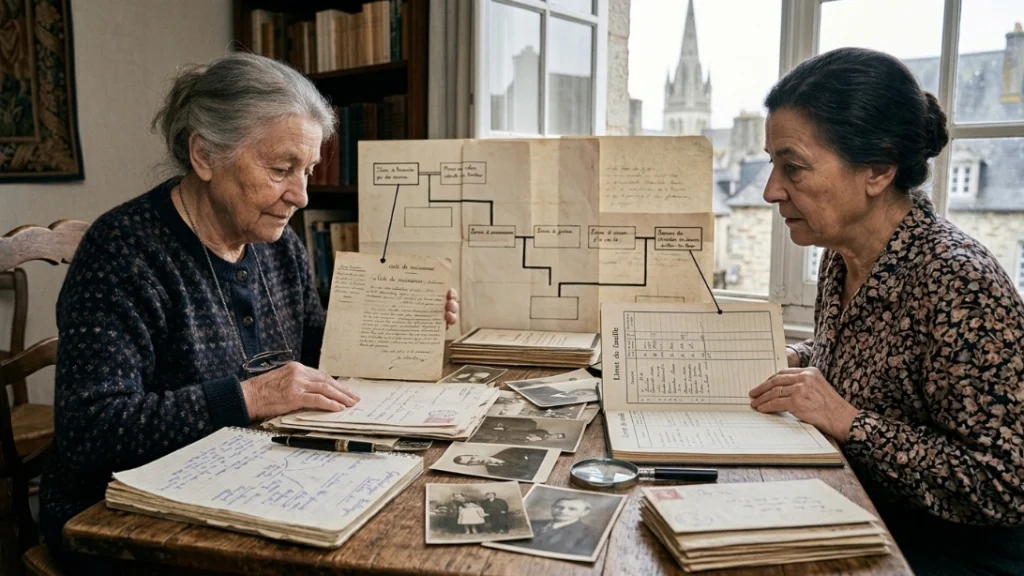
The French wording is important.
The notice describes her as:
“Madame Jean-Charles BELLÉGUIC née Jeannine BLEUZEN”
Here, née Jeannine Bleuzen identifies her birth or maiden surname.
This confirms that Jeannine Belleguic and Jeannine Bleuzen were names associated with the same woman.
That fact helps explain why searches using either surname can lead researchers toward the same family record.
But there is another complication.
Near the end of the same notice, the family thanks:
“Jeannine Bleuzen, sa belle-soeur”
In French, belle-soeur means sister-in-law.
This is a crucial identity detail.
The notice therefore mentions:
They are not necessarily the same person.
This creates a genuine genealogy hazard.
A researcher searching only for “Jeannine Bleuzen” could potentially combine records belonging to two different women.
That distinction is more valuable than many of the biographical details repeated by secondary websites.
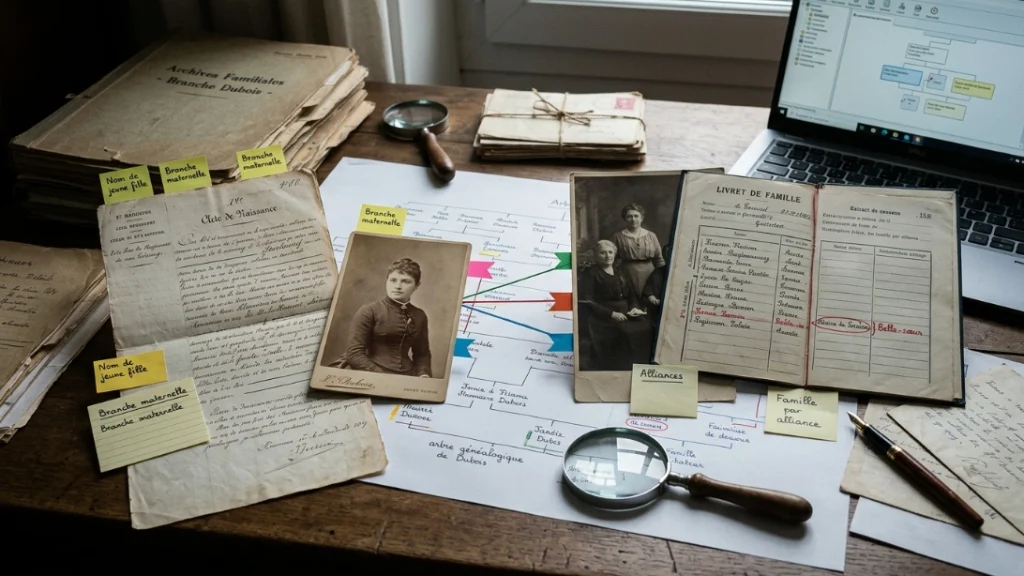
Names are often treated as unique identifiers.
They are not.
The problem becomes greater when two relatives share the same given name and surname.
In this case, one woman carried Bleuzen as her maiden surname. Another woman in the same family was also identified as Jeannine Bleuzen.
Future researchers should therefore avoid matching records using the name alone.
A reliable identity match should consider:
This is especially important when researching historical French civil records.
The obituary gives a surprisingly detailed picture of Jeannine’s immediate family.
It names three children:
Gilles and Evelyne, Catherine and Victor Coulis, and Pierre-Yves and Patricia.
It then identifies six grandchildren:
Philippe, Marie, Charlotte, Anne-Gaëlle, Camille, and Jean-Victor.
The notice also states that Jeannine had ten great-grandchildren.
These details are significant because they come directly from the family notice.
They are not merely numbers copied from an anonymous biography.
The obituary identifies Yvette Ollivier as Jeannine’s sister.
It separately mentions Jeannine Bleuzen as her sister-in-law.
This provides another reason to avoid flattening every appearance of “Jeannine Bleuzen” into one identity.
The relationship wording matters.
A sister, a sister-in-law, and a maiden surname create different genealogical paths.
Those paths should remain separate unless another record connects them.
The notice opens with three place names:
Quimperlé, Lorient, Guidel.
These locations establish a regional connection.
The funeral itself took place in Quimperlé.
The notice also thanks the HAD de Lorient, providing a direct connection with Lorient healthcare services.
Guidel is likewise included in the notice’s opening location line.
These references should not be turned into unsupported claims about birthplace or lifelong residence.
The document establishes connections.
It does not explain every connection.
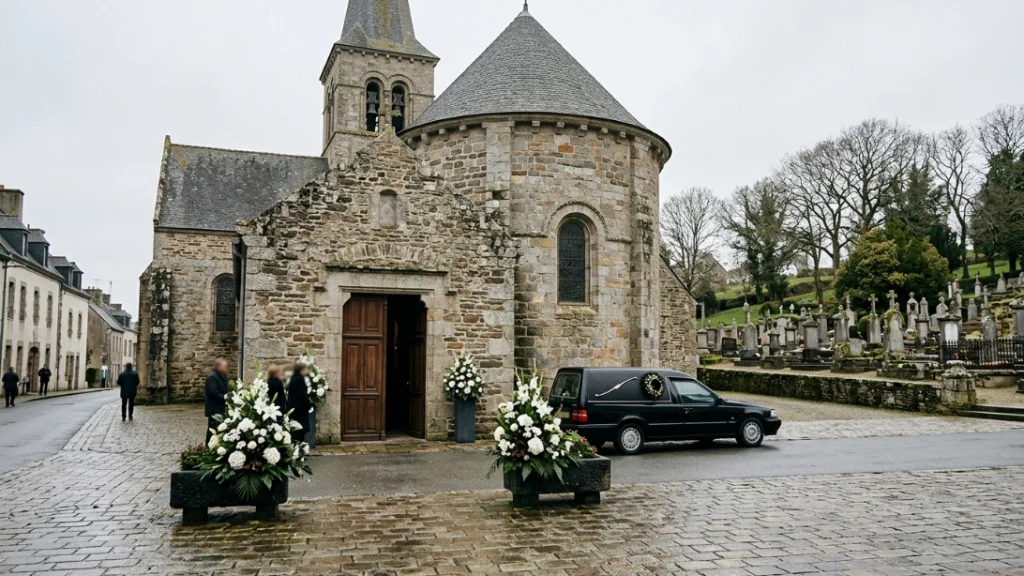
The death notice provides exact ceremony details.
The funeral ceremony was scheduled for:
Friday, April 25, 2025, at 2:30 p.m.
It was held at Notre-Dame de Quimperlé.
The notice says the ceremony was followed by burial at Saint David Cemetery.
This gives a clear timeline.
Jeannine died on April 18. Her funeral ceremony followed one week later.
The family notice contains another overlooked layer.
The family thanked Mme Marielle Le Romancer, described as Jeannine’s dame de compagnie.
It also thanked Dr. Philippe Gourden.
The notice additionally acknowledged staff from Résidence Edilys and the HAD de Lorient.
These references suggest that several people and services were involved in her later-life care.
However, the notice does not provide a detailed medical history.
That distinction matters when secondary websites add medical claims.
Cybille.fr displays 1931–2025 and gives Jeannine’s age as 93.
That makes 1931 consistent with the reported age.
However, the family death notice does not disclose an exact birth date. Its birth information is reported as not communicated.
Therefore, 1931 should be described carefully.
The strongest formulation is that Cybille.fr lists 1931 as the birth year and records her age as 93.
That is different from claiming that an independently located civil birth record has confirmed the date.
The biggest unresolved part of the online biography concerns Jeannine’s alleged professional career.
A page on articlecontent.co.uk presents a much more elaborate story. It reportedly describes Jeannine as a neuropsychologist and adds institutional details involving Rennes and the Pitié-Salpêtrière environment.
Those claims deserve separate treatment.
They do not appear in the family death notice.
The notice discusses her relatives, funeral, care services, and local connections. It does not describe a neuropsychology career.
The online professional story also reportedly refers to an “Institut Belleguic.”
This is an unusually specific institutional claim.
Yet the research described for this investigation did not identify an independent institutional record supporting it.
There was no established university or research record presented alongside the claim.
That creates a major source problem.
A detailed professional biography should ideally be supported by professional records, institutional pages, publications, or other independent evidence.
Not by itself.
The absence of an online professional record cannot prove that a person never worked in a particular field.
However, the evidentiary situation is still important.
The family notice provides strong evidence for Jeannine’s family identity. The neuropsychology narrative comes from a separate secondary source and lacks the same documentary foundation.
The responsible conclusion is therefore:
The neuropsychologist biography is unsupported by the identified primary family record and lacks independent corroboration in the evidence examined here.
Calling it definitively AI-generated would require additional evidence about its authorship or source history.
There is another source issue worth separating.
The death notice exists within the French avis de décès publishing ecosystem associated with major regional press networks.
However, that should not automatically be described as an Ouest-France news article.
A family death notice and a newspaper’s editorial report are different publications.
The safest wording is that the notice appears within a death-notice network associated with the relevant French press ecosystem.
It should not be presented as evidence that an Ouest-France journalist wrote a biographical article about Jeannine.
That distinction prevents a simple notice from becoming an exaggerated media claim.
The investigation also corrects an earlier assumption.
Some secondary pages reportedly published the names of Jeannine’s children or grandchildren.
Those details initially looked suspicious because different websites emphasized different family members.
The original notice shows why that conclusion was premature.
The children named online correspond with the actual notice.
The six grandchildren also correspond with it.
The problem was not necessarily the family information.
The bigger problem was the addition of unrelated professional material without comparable evidence.
The documented record supports several facts about Jeannine’s final family circumstances.
She was identified as Jeannine Belleguic, née Bleuzen.
She died on April 18, 2025, according to the family notice.
Cybille.fr records her as 93 and lists 1931–2025.
Her notice names three children, six grandchildren, and ten great-grandchildren.
It identifies Quimperlé, Lorient, and Guidel.
It gives her funeral date, church, and burial location.
It also names people and services involved in her later care.
Most importantly, it identifies another Jeannine Bleuzen as her sister-in-law.
That last detail should remain attached to the record whenever her maiden name is discussed.
Other claims should remain separate from the confirmed family record.
These include:
The distinction is not about being skeptical for its own sake.
It is about matching the strength of a claim with the strength of its evidence.
Anyone investigating the family should search both surnames.
Useful searches include:
"Jeannine BELLÉGUIC" "18 avril 2025"
"Jeannine BELLÉGUIC" Quimperlé
"Jeannine Bleuzen" "BELLÉGUIC"
"Jeannine Bleuzen" Lorient
Researchers should then compare relatives and dates.
The phrase “née Jeannine Bleuzen” is particularly useful.
So is “sa belle-soeur”, because it can help separate the deceased woman from her sister-in-law.
This is a better approach than searching the name alone.
This case demonstrates how online biography research can go wrong.
The original record is not actually empty.
It contains family names, relationships, places, dates, funeral arrangements, and care references.
The problem begins when separate information is added without showing where it came from.
Once real facts surround an unsupported claim, the entire page can appear authoritative.
Readers then assume that every sentence has the same evidentiary foundation.
It does not.
Jeannine Belleguic’s documented story is primarily a family and local record, not a celebrity biography.
The strongest evidence identifies her as Jean-Charles Belleguic’s wife, née Jeannine Bleuzen, and records her death on April 18, 2025.
Her family notice names her children, grandchildren, great-grandchildren, sister, and sister-in-law. It also records her funeral arrangements and several people or services involved in her later care.
One detail deserves special attention: another Jeannine Bleuzen was her sister-in-law.
That means future researchers must not treat every record for “Jeannine Bleuzen” as belonging to the deceased woman.
Meanwhile, the elaborate neuropsychologist story remains on a different evidentiary footing. Its detailed claims are not supported by the family notice and require independent documentation before they can be treated as established biography.
The most accurate picture is therefore neither an empty biography nor an elaborate professional profile.
It is a well-documented family notice surrounded by a much less certain online narrative.
Searching for thesindi com can be confusing because several websites use names that look very similar. The domain most directly associated with this search is thesindi.com, an online publishing website…

People searching for Magnexusbuzz com are likely trying to answer a basic question: what exactly is this website, and what should they know before using or trusting information associated with…
If you searched for “connectivity issues HSSGamepad,” your controller probably will not pair, keeps disconnecting, appears connected but does nothing, or responds slowly. The fastest solution is to identify where…
Helonium is a name for the helium hydride ion, written as HeH⁺. It is a positively charged molecular ion formed from helium and hydrogen. It is not a newly discovered…
20xBusiness.com is an informational website that publishes articles about business growth, digital marketing, financial planning, market expansion, automation, and team management. It appears to function as a business-advice publication rather…
Yes, the Cadillac LYRIQ’s driving modes can affect battery consumption and real-world range—but they do not provide separate, fixed range allowances. Selecting Sport, Snow/Ice, Tour or My Mode does not…